
Reviewed October 2026
To join the French Foreign Legion, you need to travel to France and apply in person at a recruitment centre. You will go through medical checks, fitness tests, logic tests and interviews. If you are selected, your first contract is for five years and you will start basic training at the 4th Foreign Regiment.
When I joined in 2012, I found the process confusing. This guide explains what to prepare, what to bring and what happens after you walk through the gate. It also includes the small things I wish someone had told me before I left home.
1. Check the requirements and prepare seriously
You do not need a school diploma. You do need to read and write in your own language. Your fitness, health, test results, motivation and behaviour all matter. A good running time will not make up for a bad attitude.
How old do you need to be?
Experience
Based on the recruitment information I use, the age range to plan around is 17 years and 6 months to 39 years and 6 months. If you are near the upper limit, do not wait until the last minute. Leave time for selection and signing your contract.
Under 18, you need extra paperwork from your parents or legal guardians. If you are only a few months away from your 18th birthday, my advice is to use that time to prepare and arrive as an adult.
Recruitment in 2026
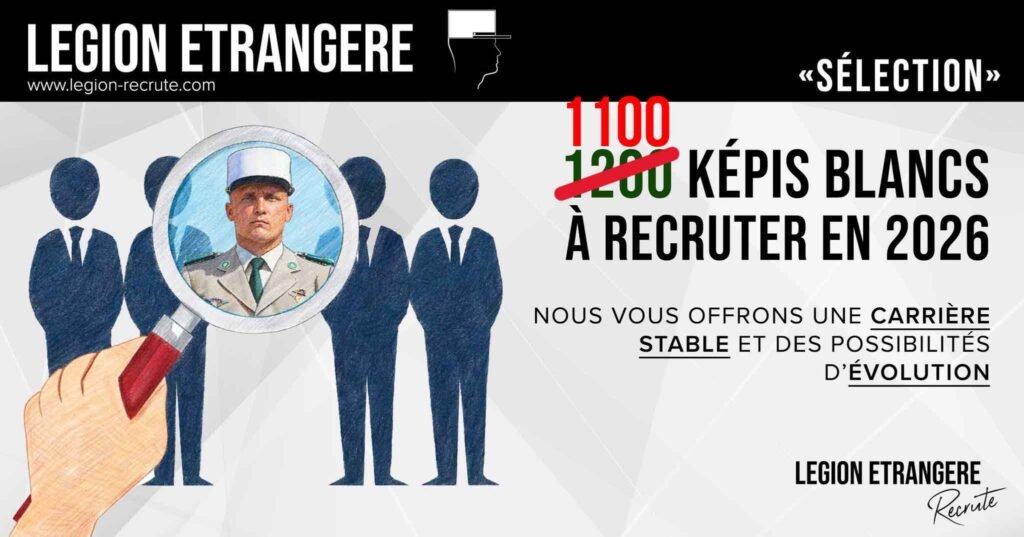
The planning figure I reported for 2026 is about 1,100 new recruits. With roughly 8,000 volunteers presenting themselves in a year, that gives you an idea of the competition. It is not a calculation of your personal chances.
You need to arrive ready. The Legion can choose between candidates, so meeting a minimum does not mean you will be selected. I explain the figures and the preparation advice in my 2026 recruitment article.
My advice on fitness and BMI
If you cannot do four clean pull-ups, do not buy your plane ticket yet. Aim for at least eight, and train with the Luc Léger beep test before you go. These are preparation targets from me, not a promise that a certain score gets you in.
The published BMI range is 18 to 30. BMI is your weight in kilograms divided by your height in metres squared.
Experience
My advice is to arrive lean and fit, with a BMI around 25 or below if you are carrying extra body fat. At a BMI close to 30, you will usually be in a weaker position than a leaner, well-prepared candidate, unless you are particularly muscular and very fit. That is my practical assessment of the competition, not an official BMI limit.
Judge your running and pull-ups as well as your weight. You are preparing for military training, not a bodybuilding competition.
2. Choose a recruitment centre
If you are flying into Paris, Fort de Nogent in Fontenay-sous-Bois is a practical option. It is outside central Paris. This is where I arrived, and you can read that part of my story.
You can also present yourself in Aubagne. Other information posts are listed in the official recruitment-centre directory. Check the address and opening hours of the exact centre you choose.

Have a plan for getting home if you are not selected. When I joined, candidates who had come through Paris could be sent back there after failing in Aubagne. Do not build your travel budget around getting a free ticket today. Ask what applies to your situation.
Download your route before leaving home. Check it again when you arrive, especially if there are transport disruptions. Getting to France is your responsibility, so allow time and money for the whole journey.
3. Prepare your documents
Official Information
For Schengen nationals, and nationals of Ireland, Cyprus, the UK, Monaco and Andorra, the Legion lists a national ID card or passport. Other candidates need a passport. Read the official document requirements for your situation.
Bring the original passport or ID, not just a photo or copy. A residence permit does not replace the required passport. A birth certificate showing your parents is needed for identity regularisation before the end of your first year. These points are explained in the official recruitment FAQ.
Under 18: bring handwritten consent from both parents or legal guardians, copies of their IDs, and any applicable death or emancipation documents. Foreign minors need the required documents translated into French by an accredited translator.
Useful supporting papers include your driving licence, birth and family records, qualifications and military service records. Bring records of past surgery or illness, your health booklet if available, and glasses if you use them.
My advice before you leave
Bring a birth certificate now if you can get one easily. If an official French version is available in your country, take it. Keep your papers together in a folder, with copies stored safely for yourself.
Separate the paperwork needed for recruitment from the paperwork needed to travel. A document the Legion accepts at its desk is not automatically enough to board a plane or enter France. Check your own travel and visa requirements before booking. The Legion does not arrange your visa, invitation or flight.
If you have served in another army, bring your service papers. Do not turn up with a complicated administrative situation and expect someone else to sort it out for you.
4. Pack your bag
Keep it simple. Bring useful clothes and basic washing kit, not a bag full of things you bought to look like a soldier.
Official Information
The official packing list includes sports shoes, toiletries and three changes of underwear, T-shirts and socks. It sets a cash limit of €70 and prohibits weapons, including knives.
Experience
I still recommend seven pairs of underwear and seven pairs of socks. Three is too little for comfort during basic training. You receive underwear in Aubagne, but in my experience it is not very comfortable. Bring your own and think beyond your first few days of selection.
- Two or three T-shirts. Simple clothes that are easy to wash.
- Seven pairs of underwear and seven pairs of socks. Choose comfort.
- A good pair of running shoes. Wear them before you travel.
- A towel and shower slippers.
- Soap or shower gel, a toothbrush and toothpaste.
- A razor, spare blades and shaving gel.
- Washing soap and a small brush. You may need to wash clothes by hand.
- A little toilet paper. There is usually some available, but not always.
- A small notebook and pen. Write down important phone numbers.
- A small French dictionary and a book to read. There can be a lot of waiting.
- A simple set of civilian clothes. Think about the season when you may next use them.
- A small amount of cash within the €70 limit.
A few things you should not forget
Write your parents’, siblings’ and friends’ phone numbers in your notebook. So you won’t be like an idiot when you have the chance to call home and realise all the numbers are on a phone you cannot use.
Leave your laptop and tablet at home. Ask someone to send them later, once you have finished basic training and know what your regiment allows.
Do not bring a knife, multitool, uniform or a load of tactical equipment to impress anyone. You are going there to become a soldier. You do not need to dress up as one before you arrive.
The official list also says not to bring vehicle or house keys and lists jewellery and valuables as unnecessary. Arrange these things before leaving home.
5. Arrive at the recruitment centre
Fort de Nogent and Aubagne are listed as open 24 hours a day. Smaller information posts have their own office hours. My advice is to arrive on a weekday during the day, preferably in the morning. It is easier for you and the people receiving you. Check the centre directory before travelling.
At the gate, explain that you want to join the French Foreign Legion. Expect your identity documents and bag to be checked. Follow instructions and keep your important papers easy to reach.
You may be asked to do pull-ups early in the process. Be ready to show clean repetitions rather than trying to argue that a half-rep should count. I explain the preparation in the selection fitness guide.
Then expect to wait. There may be forms, interviews, small jobs and more waiting. You may also meet candidates who are much stronger than you. Do not let that destroy your motivation. Fitness matters, but it is not the only thing they are looking at.
6. Prepare for the medical checks
Know your medical history and bring the papers that explain it. Have your teeth checked before leaving. Getting a problem treated at home is easier than discovering it during selection.
Expect a medical examination and urine testing. A doctor may also examine your genitals. Do not be surprised by it. The purpose is to assess whether you are fit for service.
Experience
My advice about protein shakes stays the same: do not spend the weeks before selection drinking them day and night. Eat properly and keep your preparation sensible. Supplements will not make up for poor training.
If a urine test shows excess protein, the doctor may ask for further checks. That does not automatically mean kidney disease, and you cannot assume protein powder caused the result. Urine protein can rise for several reasons, including hard exercise. Let the doctor interpret the test.
Read the medical tests guide for more detail. A blog can help you prepare, but the recruiting doctor decides your medical fitness.
7. Pass the main selection tests in Aubagne
If you start in Paris and pass preselection, you continue to Aubagne. Staff will give you the travel instructions. Do not plan your trip around an old claim that transfers always happen on a certain day.

Fitness tests
Official Information
The official tests page lists overhand pull-ups and the Luc Léger beep test. It gives level 5 as the minimum for Luc Léger and strongly recommends being able to swim 25 metres without help.
- Pull-ups: use an overhand grip, start with straight arms and return to the bottom between repetitions. Train clean pull-ups.
- Luc Léger: practise the actual beep test. Pacing and turning matter as well as your general running fitness.
- Swimming: arrive able to swim at least 25 metres without assistance. Prepare for this as well.
My preparation targets are eight clean pull-ups and level 8 or 9 on the Luc Léger. These are my recommendations, not official selection thresholds, and they do not guarantee acceptance.
Logic tests and interviews
Practise logic questions so you understand how to work through them under time pressure. You do not need specialist knowledge, but practice can help you work faster. The IQ test guide explains what to work on.
You will also answer questions about your life and why you want to join. Know your own reasons. Do not arrive with a speech copied from the internet. Listen to the question and answer it clearly.
The Legion is looking for people who can serve and complete their contract. Explain why you want that life and show it in how you behave during selection.

Legion Training
Prepare for selection.
Get ready for the French Foreign Legion with practical training tools.


8. Start your life as a legionnaire
Waiting for the final decision is a moment you will remember. If you are selected and complete the joining formalities, basic training comes next. Passing selection is the beginning of the job.
You go to the 4th Foreign Regiment in Castelnaudary for about four months of initial training. This is where the practical things in your bag, including those extra pairs of underwear, become useful.
If you want to understand what the life feels like, start with my stories from the beginning. You can also read about pay in the French Foreign Legion and the career path.
Prepare seriously, keep your head clear and arrive ready to work.
LegionStories is an unofficial website. I served in the French Foreign Legion from 2012 to 2020 and continue to keep my knowledge of the Legion up to date thanks to my current job and friends.


Leave a Reply