Reviewed October 2026
Can you join the French Foreign Legion if you wear glasses, have an old injury, or have undergone surgery?
These are some of the questions I regularly receive from people preparing to join the Legion.
I spent eight years in the French Foreign Legion, but there’s one thing I can’t do: tell you whether you’ll pass the medical examination. Please don’t send me detailed personal medical information. Even with your full medical history, I couldn’t give you a reliable answer. Only a military doctor can decide whether you’re medically fit to serve.
What I can do is explain the medical requirements, how the examinations work and what you should know before travelling to France.
1. How do the medical tests work?
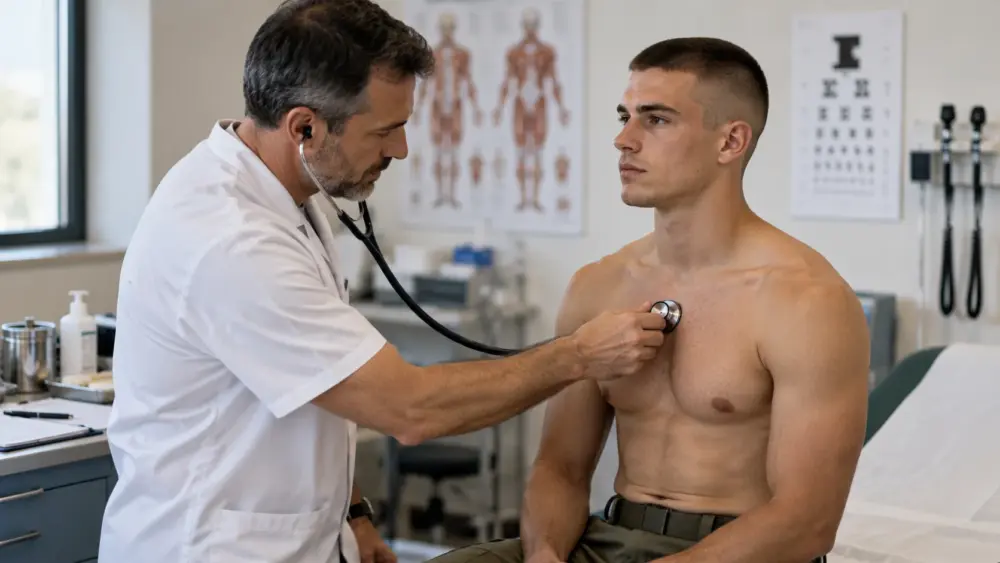
The medical examinations take place during the recruitment and selection process, before you sign your contract.
You’ll normally have your first medical examination at Fort de Nogent, near Paris, or in Aubagne, depending on where you begin the recruitment process.
If you continue through selection in Aubagne, you’ll undergo further medical checks. You can also read my personal account of joining the Legion.
Experience
When I went through selection at Fort de Nogent in 2012, the doctor even examined my testicles. I wasn’t expecting that part of the medical examination!
What does the military doctor check?
Being strong and physically fit doesn’t mean you’ll automatically pass the medical examination.
The doctor will check your general health, ask about previous injuries or operations, and look for medical problems that could make military service difficult.
A legionnaire must be able to train in demanding conditions and deploy abroad.
If the doctor needs more information, you may have to take additional tests or see a specialist. You can also have further medical checks after joining.
If you’ve had surgery or a serious illness, don’t assume you’re fit for service just because you feel healthy today.

2. What is SIGYCOP?
Official Information
SIGYCOP is the medical classification system used by the French armed forces to assess a candidate’s fitness for military service.
After your medical examination, the military doctor assigns a score to seven different aspects of your health.
What do the letters mean?
| Letter | Medical assessment |
| S | Shoulders, arms and upper limbs |
| I | Hips, legs and lower limbs |
| G | General health and physical condition |
| Y | Eyesight |
| C | Colour vision |
| O | Hearing |
| P | Psychological assessment |
How does the scoring work?
Most SIGYCOP categories are scored from 1 to 6, with lower scores generally indicating better medical fitness.
There are two exceptions:
- C (colour vision): 1 to 5.
- P (psychological assessment): 0 to 5. The initial P0 classification is used during recruitment and probation.
Each category is assessed separately. You don’t add the seven numbers together to obtain a final score.
Your medical profile must meet the requirements for the job or activity concerned.
What SIGYCOP score do you need to join the Legion?
The general medical standards for enlistment in the French Army include the following profile:
| S | I | G | Y | C | O | P |
| 3 | 2 | 3 | 5 | 4 | 3 | 0/1 |
These numbers represent the maximum permitted scores, not the exact scores you need to obtain.
For example, someone with an eyesight score of Y2 meets a Y5 limit.
However, being medically fit for general enlistment doesn’t automatically mean you’re fit to become a paratrooper, mountain soldier or military diver.
These activities have their own medical requirements.
Legion Training
Prepare for selection.
Get ready for the French Foreign Legion with practical training tools.


3. Eyesight, glasses and laser eye surgery
Can you join the French Foreign Legion with glasses?
Yes. Wearing glasses doesn’t automatically prevent you from joining the French Foreign Legion.
The important thing is whether your eyesight meets the required medical standards.
The military doctor will test your vision and assign your Y score. Colour vision is assessed separately under the C category.
Colour blindness can also affect your chances of joining. Some forms are accepted under the general medical standards, but more severe colour-vision problems can make you medically unfit.
If you wear glasses, bring them to selection.
What about contact lenses?
If you wear contact lenses, bring your glasses too. The Legion’s official recruitment website specifically tells candidates who need vision correction to bring their glasses.
Wearing contact lenses doesn’t automatically prevent you from joining the Legion. But you shouldn’t expect to use them during every activity.
Do note that French Army regulations prohibit wearing contact lenses during overseas operations (OPEX) and certain commando courses.
Parachuting and mountain service also have their own eyesight requirements. Being medically fit to join the Legion doesn’t necessarily mean you’re fit for these activities. A military doctor will check that separately.
Can you join after laser eye surgery?
Having had laser eye surgery doesn’t automatically prevent you from joining the Legion.
The medical assessment depends on the type of procedure, the result and how much time has passed since the operation.
For common refractive eye procedures, the military regulations generally require a recovery period of at least six months.
There are additional restrictions for military parachuting. In particular, the operation must have been performed at age 21 or older, and at least six months must have passed.
If you’ve had eye surgery, bring your ophthalmology reports and any documents concerning the operation.
4. Which medical conditions can prevent you from joining?
The Legion’s official recruitment website lists several medical conditions that may prevent you from joining, including tuberculosis, hepatitis, cancer, HIV, diabetes and certain psychiatric conditions under treatment.
Serious eyesight or hearing problems can also make you medically unfit.
Previous injuries and operations may cause problems too, especially if you haven’t fully recovered. The Legion mentions unstable knees, repeated kneecap dislocations and the complete loss of a finger among its examples.
What happens if you’re declared medically unfit?
Not every medical problem means your chances of joining the Legion are over. If you fail selection for a medical reason, the decision may be temporary or final.
Temporary failure: You may need treatment or more time to recover. The waiting period can range from a few months to a year. You can try again after that period, following the instructions you receive.
Final failure: You normally can’t return for another selection. The Legion allows candidates to write to its command about the decision, but a final rejection is generally irreversible.
Keep the documents you’re given before leaving the recruitment centre.
5. BMI, teeth and other medical requirements
Body mass index (BMI)
Official Information
The French Foreign Legion requires candidates to have a BMI between 18 and 30.
BMI is calculated by dividing your weight in kilograms by your height in metres squared.
For example, someone who is 1.75 m tall and weighs 72 kg has a BMI of 23.5.
Being within this range doesn’t mean you’re physically prepared for selection. You still need to train for the Legion’s fitness tests.
Dental requirements
Your teeth must be healthy or properly treated. The Legion requires a masticatory coefficient of at least 40%.
This isn’t simply a percentage of how many teeth you have. Each tooth receives a score depending on its position and whether it makes proper contact with the opposite tooth.
For example, a healthy molar is worth 5 points. Four upper molars and four matching lower molars could theoretically give you 40 points, even though you’d only have eight teeth left.
Damaged teeth or teeth that don’t meet properly can lower your score. Dental prostheses can also be taken into account.
If you have missing or damaged teeth, I recommend visiting a dentist before travelling to France.
Vaccinations
During recruitment, the medical staff will check if you have any health problems that could prevent you from receiving the required military vaccinations.
Once you’ve signed your contract, the Army takes care of the vaccinations you need during incorporation.
Experience
I didn’t bring my vaccination record when I joined the Legion, and it wasn’t a problem. If you have yours, bring it, but don’t worry too much if you don’t. The FFL will check which vaccinations you need.
One important thing: military vaccinations aren’t optional. Refusing them can prevent you from joining or continuing your service.
6. Medical requirements for specialist roles
Paratroopers — 2e REP
If you want to become a paratrooper in the 2e REP, you’ll need to pass an additional medical examination.
According to the December 2024 military instruction, the requirements for initial static-line parachuting (SOA) include:
- Height: Between 1.60 m and 2.05 m.
- Weight: Between 55 kg and 100 kg.
Your back, joints, eyesight and hearing will also be checked carefully.
Experience
During my own parachuting medical examination, I also had X-rays taken of my spine. I actually found those old X-rays again years later while emptying my locker.

Mountain troops — 2e REG
If you want to join the 2e REG, keep in mind that mountain troops have specific medical requirements.
Official Information
The initial SIGYCOP limits for mountain-troop aptitude are:
S2 – I2 – G2 – Y4 – C4 – O2 – P0/1
These requirements are stricter than those for general enlistment, particularly concerning eyesight, hearing and general physical condition.
The regulations also mention Raynaud’s syndrome, a condition that causes circulation problems in the fingers or toes, especially in cold weather. This condition is incompatible with mountain-troop aptitude.
These standards concern mountain duties and don’t necessarily apply to every job within the regiment.

Military diving
You don’t need to pass a diving medical examination to join the Legion.
However, if you want to become a military diver later, you’ll need to pass additional medical tests, particularly concerning your ears, sinuses and lungs.
Experience
I went through these examinations myself during my military career.
Being medically fit to join the Legion doesn’t automatically mean you’re fit for military diving.
7. What to bring to your medical examination
If you’ve had surgery or a serious illness, bring your medical reports. Ideally, you should also have a certificate confirming that you’ve recovered without complications.
If you wear glasses, don’t forget them.
You can also bring your health booklet if you have one, but don’t worry if you don’t.
My advice is simple: take care of any medical or dental problems you can before travelling to France. It would be a shame to spend money getting there only to be sent home for something you could have treated beforehand.
8. Final advice
Don’t rule yourself out just because you wear glasses, have an old injury or have undergone surgery. The medical requirements are more specific than many people think.
At the same time, being strong and physically fit doesn’t guarantee that you’ll pass.
Check the requirements before travelling to France, prepare properly and don’t rely too much on what you read in online forums.
Good luck with your selection!




Leave a Reply