
Life after the French Foreign Legion

Former NCO · 8 years in the French Foreign Legion · Independent site

Legionnaire thinking about life after the French Foreign Legion

Reviewed October 2026

What happens when you leave the French Foreign Legion? Can you find a good civilian job after five years? What about unemployment benefits, professional training, French citizenship or a military pension?

These are important questions, but many candidates don’t think about them before joining.

When I first went to Paris to join the French Foreign Legion, I didn’t have a detailed plan. I wanted to become a legionnaire, and that was pretty much it. I knew very little about the institution, and even less about what I would do after my military career.

Looking back, I could have prepared much better.

The Legion can give you valuable experience, qualifications and opportunities, but none of them guarantees a successful civilian career.

In this article, I’ll explain the main possibilities after five, eight or more years of service. We’ll look at employment, professional retraining, French citizenship and military pensions. I’ll also share what I learned during my own eight years in the Legion.

Legion Training

Prepare for selection.

Get ready for the French Foreign Legion with practical training tools.

Explore the app features

Practise logic and problem-solving.

Work through different question types before selection.

Give your training a plan.

Follow workout plans and practise with the Luc Léger test tool.

Prepare for your interviews.

Read a practical guide covering the selection interviews and the questions candidates are commonly asked.

Learn words you will use.

Build useful French vocabulary and listen to the pronunciation.

Download on the App Store Get it on Google Play

Leaving the French Foreign Legion after five years

The initial enlistment contract in the French Foreign Legion lasts five years. However, the decision to continue serving or leave isn’t made at the very end of that period.

The contract renewal process normally begins during the last 18 months of service. However, this doesn’t mean you must make your final decision that early.

Official Information

Under the regulations applying specifically to legionnaires, the administration must notify you in writing whether it intends to renew your contract at least six months before its expiry. If you’re offered a renewal, you can communicate your decision until the end of your current contract.

For those who decide not to reenlist after their first five years, returning to civilian life can be complicated.

During your service, much of your daily life is organised around the regiment. Once you leave, you will have to find a place where to live, manage your finances and build a new routine.

Finding a civilian job can also be difficult. Your military experience may have taught you discipline, teamwork and resilience, but employers won’t always understand what those years represent.

Without good French and qualifications recognised outside the military, your opportunities in France may be limited.

Your first civilian months will be easier if you know where you’ll live and what work you can realistically find.

Unemployment benefits after leaving the Legion

Official Information

If you leave when your five-year contract expires, you may be entitled to unemployment benefits (ARE) in France. Ending a contract normally is not the same as requesting early termination, which can affect your rights.

Don’t expect the allowance to match your military salary. Its calculation is based on your basic pay and certain residence or family allowances, while most other military bonuses are excluded.

When I left the Legion, I received a little over €1,000 per month in unemployment benefits. I was pretty surprised: while I was serving, my pay had been around €1,850 a month, including bonuses and a family allowance, as I was already married at the time. Suddenly having to get by on just over €1,000 was a big change. Before you leave, make sure you’re financially prepared for the transition, including any period without a salary.

Starting a business after the Legion

Finding a job with an employer isn’t the only option. Some former legionnaires decide to use their savings and experience to start a business.

Experience

I once heard about two Ukrainian brothers who managed to buy two apartments while serving in the Legion. After completing their five-year contracts, they started a small business.

Their story stayed with me because it showed me how savings could create options beyond a traditional job.

Of course, starting a business involves risks. If you’re planning to establish a company in France, France Travail can provide guidance and, depending on your situation, financial support.
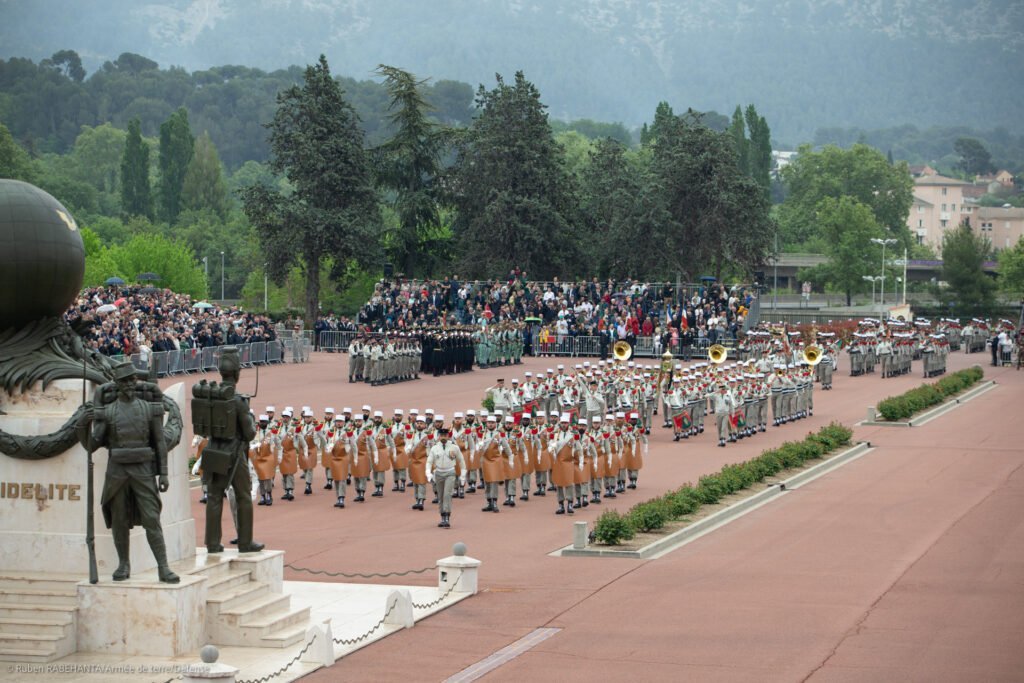
Legionnaires in Aubagne

Financial assistance: ARCE

Official Information

If you start a business in France, you may qualify for ARCE, a financial assistance scheme managed by France Travail. Instead of receiving monthly unemployment benefits, eligible applicants can receive part of their remaining ARE entitlement as startup capital.

Under the rules applicable in 2026, ARCE generally represents 60% of your remaining unemployment rights, subject to deductions. It’s paid in two parts, six months apart. You must qualify for both ARE and ACRE, and the second payment has additional conditions.

When I left the Legion, I estimated that this option could have provided me with more than €11,000.

Staying in France after leaving the Legion

For legionnaires who aren’t citizens of the European Union, the European Economic Area or Switzerland, remaining in France after military service generally requires a valid residence permit.

Fortunately, the French Foreign Legion has specific provisions.

Official Information

Under French law, legionnaires with at least three years of military service and a certificat de bonne conduite (certificate of good conduct) are entitled to a ten-year residence card (carte de résident).

This allows former legionnaires to build their civilian lives in France without first obtaining French citizenship.

Obtaining French citizenship

Legionnaires can request French citizenship after three years of service, but approval is not guaranteed.

While you’re still serving, you cannot simply apply through the civilian procedure on your own. Your application must pass through the Legion’s military administration, which forwards it to the competent authorities with its opinion.

Experience

That’s how the process worked when I obtained French citizenship.

I remember a legionnaire who started the naturalisation process on his own while he was still serving in the FFL. He was punished for it. Bypassing the military procedure can also delay your naturalisation by several years, so make sure you follow the proper channels.

Only after leaving the Legion can you apply through the civilian naturalisation procedure, but it will take a bit more time.

There is also a special procedure for foreign soldiers wounded during an operational mission.

Leaving the French Foreign Legion after eight years or more

In my opinion, staying for eight years can be a good compromise. It’s enough time to gain more experience, save some money and prepare a realistic plan for civilian life without necessarily committing to a full military career.

When I joined the Legion, French citizenship wasn’t one of my priorities. Coming from a European Union country, I already had the right to live in France and could travel relatively easily with my passport.

However, my perspective changed during my second contract. I started building a life outside the regiment and eventually decided to apply for French citizenship.

Experience

By the time I started my second contract, I had already spent some time living outside the regiment. As an NCO, I was allowed to rent a flat. That experience helped me discover everyday life in France, and I started to enjoy it.

French citizenship was no longer just an administrative question. I wanted to use a French identity card in civilian life rather than rely on my military ID. Having a second passport also seemed useful.

That’s how I eventually became French. As the Legion says: ‘French, not by blood received, but by blood shed.’

Professional retraining before leaving the Legion

In my opinion, one of the biggest advantages of staying in the Legion for eight years is the possibility of preparing for a civilian profession with financial support from the Army.

The Legion has its own career-transition service, called the Bureau d’Aide à la Reconversion de la Légion étrangère (BARLE).

Its role is to help legionnaires prepare their professional projects, find suitable training and transition into civilian employment.

In most regiments, a BARLE representative can guide you through the process and explain your options and rights. However, don’t rely entirely on that person. Make sure you understand your own rights and the opportunities available to you.

Financial assistance and training opportunities aren’t automatic. Your project must be approved, and the available support depends on your individual situation.

How does professional retraining work?

Experience

In the FFL, you cannot begin your actual stage de reconversion before completing eight years of service.

Before reaching that point, you may be allowed to attend a remise à niveau scolaire at the military training centre in Fontenay-le-Comte. This helps you refresh your academic skills, improve your French and practise maths, among other subjects. However, it isn’t the actual professional retraining course.

Once your project is approved and you’ve completed your eight years of service, the Legion can extend your contract to allow you to complete your training.

During this period, you remain a serving legionnaire and continue receiving your military pay under the applicable conditions.

Choosing your professional training

The available training options can be more varied than you might expect. You don’t necessarily have to choose from a fixed list of courses.

In my experience, it was even possible to request training in your home country if the course you needed wasn’t available in France.

That flexibility has limits: the Legion still has to approve your project.

You’ll need to prepare a detailed professional project explaining what you want to do, why the training is necessary and how it will help you find civilian employment.

Your BARLE adviser can help assess whether the training fits the professional project you’re proposing.

Working in private security after the Legion

Private security is one of the first civilian options many former legionnaires consider, but the jobs and working conditions vary considerably.

Before leaving, your reconversion adviser can help you prepare a passeport professionnel, describing your military experience and qualifications.

Depending on your service record, you may qualify for jobs ranging from supermarket security to cash transport. However, you’ll still need the appropriate CNAPS professional card.

Employers generally appreciate former legionnaires for their discipline, reliability and experience. But nobody will pay you more simply because you served in the Legion.

Basic security jobs can be a starting point, but don’t settle for them without exploring how to make better use of your skills. Consider it a safety net, not a permanent career choice.

Experience

When I left the Legion, I received three job offers in this field, even though I wasn’t looking for that kind of work.

Leaving the Legion with a military pension

Military pension eligibility

One important advantage of a long military career is the possibility of receiving a pension well before the usual civilian retirement age.

Official Information

Under the rules in force in 2026, legionnaires who are not commissioned officers can generally receive a military pension immediately after completing 17 years of effective service.

However, there’s an important difference between 17 years and 19 years and six months. Leaving before 19 years and six months can result in a pension reduction, called décote carrière courte.

The amount you receive also depends on your rank, pensionable pay, years of service and applicable pension credits.

Always request an individual pension estimate before leaving.

Working after military retirement

Receiving a military pension doesn’t necessarily mean you’ll stop working. Some former legionnaires choose to start a second career to increase their income or simply stay active.

Experience

I know of an adjudant who retired after 22 years of service. His pension was around €1,500 per month, which wasn’t enough to support his family comfortably in France. He eventually found a job as a bus driver.

His example shows that a military pension can provide some financial security, but it doesn’t always guarantee a comfortable lifestyle.

Fortunately, under current rules, military retirees can generally combine their pension with income from private-sector employment.

Other career opportunities for former legionnaires

International organisations and private companies

A military career can also open doors beyond basic security jobs.

I know former legionnaires who found work with the United Nations. Others have joined international organisations, such as the OSCE, or private companies like G4S.

But don’t imagine these organisations will offer you a job simply because you’ve served in the Legion. You still need relevant qualifications, good language skills and a clear professional project.

These careers can involve very different entry requirements, from specialist qualifications to language proficiency and previous operational experience.

Joining the Police or Gendarmerie

Some former legionnaires decide to continue their careers in the Police municipale, French National Police or Gendarmerie.

This can be an interesting option if you want to remain in a structured environment, but your military experience doesn’t guarantee you a position.

For operational roles, French citizenship is generally required. You’ll also need to meet the recruitment conditions and pass the appropriate selection process.

Your military background can be an advantage, and specific recruitment pathways may be available depending on your situation.

Finding your own path

Every legionnaire’s path is different. Some want a stable job and more time with their families. Others build businesses or pursue international careers.

After eight years in the Legion, I wouldn’t judge someone’s transition by their job title or salary alone.

One thing I’d encourage every legionnaire to do, whatever their plans, is to learn French properly.

Even if you eventually return to your home country, speaking another language is a valuable skill that stays with you long after you’ve taken off the uniform.

From the 2e REP to civilian leadership

Experience

To show how far a career after the Legion can go, I’d like to share the example of Tibor Vass. He spent ten years in the 2e REP, including five years with the GCP. After leaving in 2008, he founded LPN Group in 2009 with just €1,000. Today, he also leads the Institut Français de Sécurité (IFS).

Of course, you don’t have to start your own business to find a position with responsibilities. In October 2026, BSL Sécurité advertised a security operations manager position in Marseille, offering approximately €2,850–€3,530 gross per month. The job involves managing security teams, coordinating several sites and maintaining client relationships. It also requires relevant civilian qualifications and experience.

For comparison, Apec’s professional salary guide indicates that 80% of advertised private security management salaries range from €32,000 to €58,000 gross annually, averaging around €45,000.

These figures aren’t guaranteed, but they show the opportunities available beyond entry-level security jobs.

Final thoughts on life after the French Foreign Legion

Leaving the Legion can be just as significant as joining it. For some, it means returning to their home country. For others, it’s an opportunity to build a completely different career or start a new life in France.

I didn’t think much about civilian life when I joined. Eight years later, I understood how much difference a good plan, some savings and the right qualifications could make.

If you’re a former legionnaire, I’d be interested to hear what you did after leaving. And if you’re still serving or thinking about joining, feel free to ask your questions in the comments. I’ll do my best to help.


Legion Training App

Training plans, fitness tests and structured preparation for candidates.

Download Legion Training on the App Store
Get Legion Training on Google Play

Comments

Leave a Reply

Your email address will not be published. Required fields are marked *

  1. Jo

    Hi Aron. I have a friend who spent 35 years serving in the Legion. He’s now really struggling with civilian life. He’s a relly proud man. How can I get some help for him. He will be 60 this year.

  2. future of ffl

    can i com inn ffl if i use lenses -2 , i use glases and lenses.

  3. Haltarys

    Do you get to keep anything from the Legion? Like your képi or your beret or your uniform?

  4. Antonio Mara

    Hi,
    I deserted from FFL some 30 years ago. Never had intentions to go back or live in France. Now , suddenly , because I work for one international company and they got a project in France, I need to go back in France. In my company they know about my past and they want me to clarify my status in France. Am I still a fugitive, should I be arrested if my name pops out somewhere by some chance?Is there anywhere I can seek for legal advice regarding this issue ‘ Can anyone help me with some reasonable advice , since I need to present some kind of a proof to my company. Thanks in advance

  5. DJ

    Hi, Aron! About what percentage of legionnaires re-enlist after the first five years?

  6. Richard

    Taylor, I am an ex Legionnaire, served between 1980 -1990. An ex legion friend of mine, now living in Texas, completed his pilots licence after leaving the legion, but could not get a job with it.
    so like many of us went into the private security industry, which is where I met him, he served after I left the 2e REP.

    1. Farzan

      Hi Richard,

      Hope you are doing well !

      Can you please tell me more about this how is the life there Because you have real life experience in it..

  7. Lee

    Hi Aron, thank you for being so helpful and taking the time to answer the many questions that people have for you. I have a question of my own that I’ve had no luck in finding an answer to. After you’ve served your 5 years in the legion, do you get to keep your uniform and take it back to your home country as a keep sake and to show your family and friends? Again, thanks so much for all of your information!

  8. Roger

    Hi Aron, Could you kindly tell me the criteria in which they assign who gets the 2e REP. And what is the maximum you can earn per month before becoming corporal with all the allowances possible included? And how much can you save per month.

  9. Florin

    Hello Aron!
    If I wear glasses will that affect me in the legion?
    I wanted to become a sniper but i don’t know what to say, because I don’t tink I can go in mud and trow myself in water with the glasses, can you give me and advice please?

  10. beau

    after you retire and receive your pension can you move back to your home country?

    1. Aron

      yes, you can

  11. Simone Cabral

    Hi and thank you for your post. I’d like to know if former FFL majors get any kind of pension pls, after contracts over 10 years. Thank you.

  12. Mwesigye David

    After 5 years can I get my French passport? What kind of job do you get after 5 years in the FFL, and how much will I earn on those jobs on average?

  13. Sanjay giri

    Is French legion army danger and they have to fight all the time ? Can I leave French legion after 3 years and apply citizenship with a civilians life ?

  14. Pritesh

    Hii can I join french special force after serving in French foreign legion for five year
    I heard that we can join french special force after obtaining french citizenship
    Plzz give me information about this

    1. Aron

      Yes, it could be an option if you manage to get the French citizenship before you reach the age limit of the unit you’d like to join.

  15. SamuelF

    What’s the age limit for joining the French police?

    1. Aron

      35 years

    2. Maria Phillips collard

      Good morning, my brother was in the FFL I think for 17 years his name was Eddie.
      My brother Eddie passed in 2001 in Australia.
      Eddie was born in Holland on the 1948.
      Eddie moved from Holland to Australia in 1956
      Would you have any information on my brother.
      Thank you in advance.

  16. smith basnet

    How much pension amount we get after we serve french foreign legion
    do we get monthly pension or not?
    if yes how much?

  17. Harry Downson

    Hi sir,
    How often can we meet out family?
    even before years of serice

  18. Benjamin Grounds

    Great article

  19. Ishu

    After 19.5 years serve in FFL ,what is my rank during I get retire?

  20. Ishu

    After 19.5 years of service in FFL ,can I join French police ?

    1. Dhiraj

      hello sir height 5 2 ok

  21. Nick

    So they will not give me citizenship after 5 years? even if i want to join Gendarmerie

    1. Aron

      No, it’s not automatic

  22. Mark

    Hi Aron, good post.

    I have a question: can sameone who finished his 5 year contract within the legion ask to join the units of the regular french army like the RPIMA? Is there any age limit? Does the previous rank automatically translate? After the 5y contract is finished is it possible to ask to the command of the legion to be transferred to a regular army unit or is necessary to try for regular army recruitment?

    Thanks.

    1. Aron

      Hey, I’ll write an article about this topic, because it needs a lot longer development than the poor one I could give you via a comment.

  23. Kevin

    Hello Aron,
    If in case i got recruited in the legions, i can summon my wife & kid to France only after 5 years of service!! Is that the truth?
    Next, what would be the pay scale for non Europeans if there is a difference for diff origins?

    1. Aron

      There’s no different in the pay if you’re coming from another country… And yes, you can move to town with your wife

  24. kostas

    Hi. I have read that the Canadian Army enlist former-FFL members.
    Is that true and under what conditions?

    1. Aron

      Hey,
      I’ve heard that the Australian army enlists former soldiers having a rare specialty, but not the Canadian.

    2. Brett

      The Australian military is now actively recruiting foreign nationals. Emphasis is on UK/US/NZ and Canadian nationals but personnel from other countries will be considered if they can pass security vetting. Residency requirements are fast tracked and you must take Australian citizenship when eligible and rescind your previous citizenship. The program began in January 2025.

  25. federico

    tengo 17 años, estoy a nada de cumplir los 18, en mi país podría estudiar y enlistarme en las fuerzas armadas, con estudio te dan un buen rango al entrar y ganas bien….pero no tanto en comparación al tiempo que inviertes estudiando, por ejemplo, ahorrando en 3 años tendria dinero para una buena casa y después invertir en un negocio…..hablamos de un proceso que combinando estudio y trabajo llevaría cerca de 8 años¡¡¡ es decir básicamente a los 32 tendría algo “bueno y seguro” .

    siempre me ha gustado lo militar, mi padre estuvo en la armada y mi bisabuelo en la caballería, pero a como lo veo económicamente hay mayor opción de progreso en la legión extranjera, básicamente un año de salario ahí equivale a tres veces lo que ganaría aquí por el mismo tiempo de servicio y mucho de estudio, incluso ahorrando la mitad seria bastante conveniente, mis dudas son ¿Qué tan difícil es entrar? ¿necesito tramitar algo como una visa o una Green card especial para trabajar ahí? ¿Qué tan riesgoso es?¿te dan una pensión cuando termina tu servicio? personalmente no me gustaría vivir en Francia, yo amo mi país y el dinero vale mucho mas acá.

    saludos desde México.

    1. Aron

      Oye, gracias por tu mensaje. No hablo español en absoluto, por lo que es un poco difícil responder a sus preguntas. Si desea leer más sobre el dinero, tiene mucha información útil en el artículo sobre salario de este artículo.

      No es demasiado difícil unirse a la legión si eres lo suficientemente bueno físicamente. Por el momento, no puede venir a Francia debido al bloqueo, pero una vez que las fronteras estén abiertas de nuevo, puede intentar unirse.

  26. Gio

    Buen dia,cuando ingresas a la legión puedes hacer diferentes curso para especializarte,para aplicar a estos cursos es por merito o esta disponibles a todos los legionarios ? ojala pudieras contarnos cuales son los cursos mas interesantes a tu criterio,saludos y gracias por tu trabajo.

    1. Arun Joseph G

      Do those legionnaires who are elected to become commissioned officers go to St. Cyr?

    2. Aron

      No

  27. Stephen

    Hey Aron, after the legion, assuming you obtained French citizenship, could you join one of the other branches of the French military? If so, what’s the cut off for age in those?
    Thanks

  28. Taylor

    Would someone be able to save up for their Pilot Training during their time in the Legion?

    Pilot training would cost about 40,000 euros and I presume on the time off that you get from the Legion you would be able to do the training along side?

    Would love your opinion on this. Thank you for everything you do brother.

    1. Aron

      Hey. Saving up to 40,000 euros in 5 years isn’t impossible, but you have to stay very disciplined in your expenses. The best is if you stay for 8 years, because the army will pay you a training or participate in your pilote course up to 12,000 euros. You wouldn’t be the first who’ll do this

  29. Jose

    Hey Aron, thanks for sharing your time at the legion with us, it is refreshing to read an up to date view of how life is in the legion, I was wondering if you can become an officer from with in the FFL, thanks again!
    Have a good day

    1. Aron

      Hey,
      Yes it’s possible, however you have to speak French at a high level and there are some other requirements but yes it’s possible.

  30. Charles Stoeng

    Good post.

    I left after 15 years (in 2000) and have since been employed as Security Manager, first in Africa and the last 15 years in the Middle East.

    The opportunities for ex legionnaires are numerous and there are excellent networks operating.

    1. Aron

      Thank you Charles for your comment. If you want to add to this article anything you find useful, don’t hesitate to contact me.

    2. Hugo

      After 5 years can I get my French passport? What kind of job do you get after 5 years in the FFL, and how much will I earn on those jobs on average?

  31. Fortune Chihota

    What are the requirements for me to join the FFL

  32. aayush chhetri

    I there any written test exam for recuirment .Exams like maths english written tedt
    If yes .Then plz ..Tell me the example of it.

    1. Samir lama

      Hi Aayush,
      During your recruitment, you will give two IQ tests. Here is how it goes:

      1) basic 10 question which is related to mathematics and simple logical questions. They will tell you that you need to get 7 or 8 correct (which everyone does).

      2) the second test is where most of the recruits fail. To make it simple, its divided in three section.
      i) puzzle solving ( more of what will happen if you do this/that type of question)
      ii) mathematics ( geometric progression and sequence type of question)
      iii) eagle view ( what will be your view from a certain angle and what will you see)

      Total time allocation for second test is one hour if i remember correctly.

      Best of luck 😀

  33. Bright Moyo

    Hie Aron thank you so much for all this understandable information you gave us. My Name is Bright a 27 years old man from Zimbabwe. I want to join the French Foreign Legions is there any way I can get a visa without the embassy requiring me to have about €3000 minimum amount in my account

    1. Phiwe

      Hi
      Let me answer you in that one,there is no way you can be granted a Shengen VISA unless you meet the requirements.
      The point is for then to try and minimise the number of immigrants

    2. Lexang Tamang

      Do i have to complete 5 years to bring my family in France? Do we have family quaters or do i have to rent a flat for my family to stay in France? Does FFL pay for the rent of the Flat Or do i have to pay from my salary?
      And at last is FFL salary enough to pay for the family of 2 ?

  34. Woody

    When out on a mission, do you feel you had adequate support such as artillery, air or back up troops if your unit got into an untenable position?

    1. Aron

      I’ve never been in an untenable position, but yes. From my point of view, all of the operations I participated in were well organized.

  35. Harsh

    Thankyou respected Mr. Aron for your kind answer. I would like 2 ask few more, does every legionnare is allowed 2 bring his family in france & gets payments n housing for family. Does everyone gets citizenship or its a myth? What benefits family gets. And what is the deployment schedule in legion will i get time 2 stay with my family at leat 3 to 4 monts a year. After retirement if i went back 2 my home country will i still get pension? I heard legion allows leave of 45 days a year as u go up the rank your vacation is extended to 60 days a year after 5 years.

    1. Aron

      Hey,
      yes you can bring your family if you finished your first 5 years or passed NCO. Not evveryone gets the citizenship, but you can obtain it after 5 years. 3-4 months at the base is normal. It can be more or less. Yes, if you go back home, you’ll continue to get your pension. And finally no, you won’t have more the 45 days off a year.

  36. Harsh

    Can we join french police? What’s the salary there. N how much pension we get after retirement if we go back 2 our home country. What is ur kind advice should we leave after 5, 8years or continue till retirement if we want 2 bring family in france? After leaving legion r their good salary jobs available in marine security n private military sector inside france?

    1. Aron

      Yes, you can join the French Police, but it’s the same like for the gendarmerie. You have a way more serious entry test than to join the Legion.
      I can’t say how much you’ll earn at the police, because it’s like in the army. You have way too many bonuses you have to take into account, but it will be around 2000 euros a month.
      If you want to bring your family in France and live an easy life, staying till the retirement could be an option, but it depends on your personal life.
      I can’t give a general advice concerning the years of service, because each case is different.
      For the well paying jobs, you shouldn’t imagine that you leave the FFL and employers will begging you to work for them for 8000 euros a week… I know some guys who are working for enterprises you mentioned, but all of them prepared their project during years and it’s not automatic.

    2. Abdul mickail ssekeba

      hello Aron.
      if I join the french foreign legion, and I become a legionnaire for example in 2 rep regiment, can I again go for a commando course? and also if I wish to go further in my education am I allowed to study any course further courses?

    3. Aron

      Yes, nowadays every regiment has its own commando unit, and once you’re in, you can apply for various specialized trainings. Depending on your interest and performance, you can follow courses such as medic, signaller, drone pilot, or sniper — among many others.